
Leadership
Above And Below The Line: The Accountability Framework That Changes Everything
Savage Strategy Co
There’s a single invisible line that separates people who grow from people who stay stuck. It doesn’t matter your background, your job title, or your circumstances. What matters is which side of the line you choose to live on — every single day.
This is the essence of the “Above and Below the Line” framework, a deceptively simple model with the power to transform how you lead, work, and live.
What Is the “Above and Below the Line” Model?
At its core, the model draws a horizontal line that divides two completely different ways of responding to life’s challenges and setbacks.
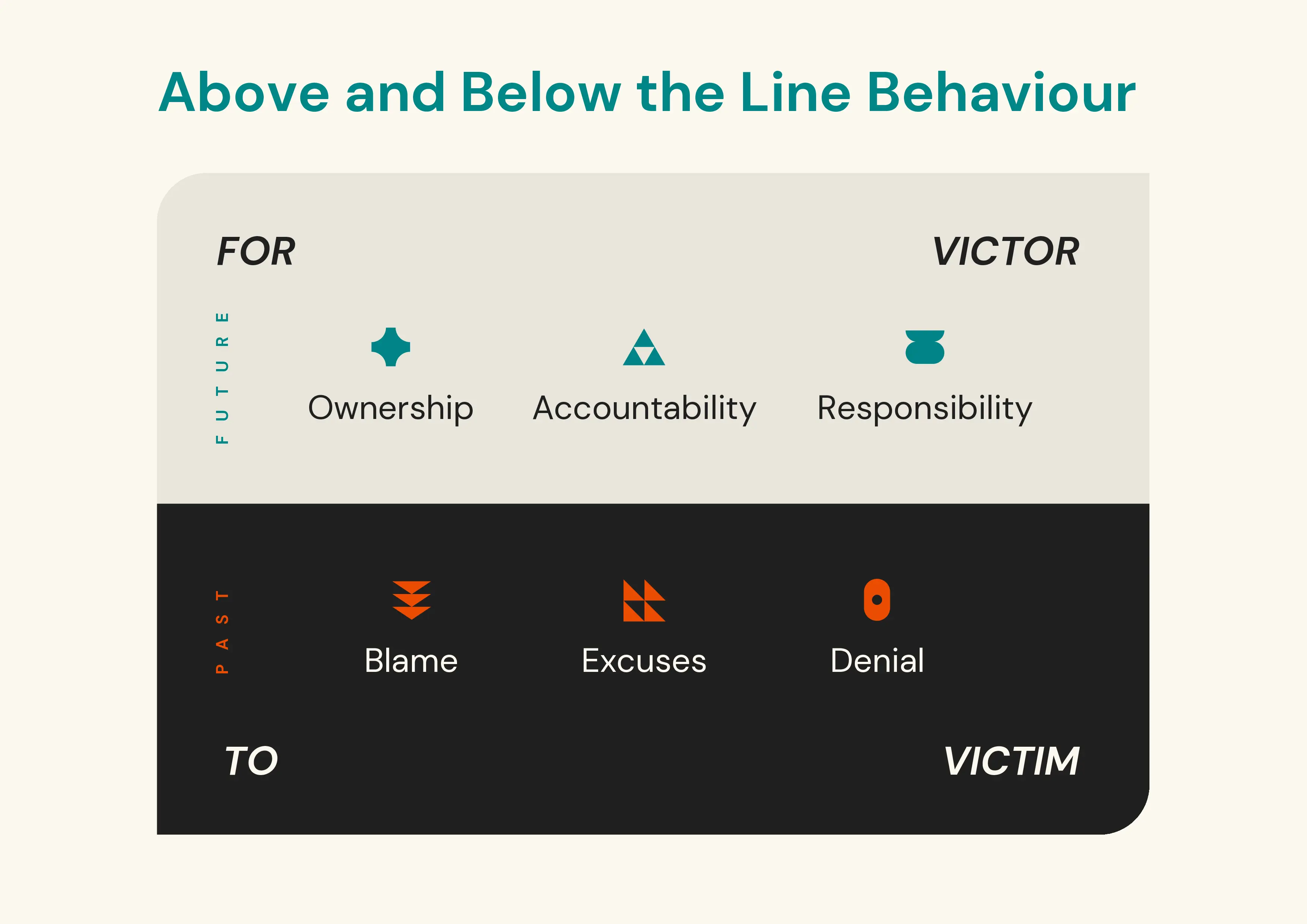
Above the line is where ownership, accountability, and responsibility live. Below the line is where blame, excuses, and denial take hold.
The choice of which side you operate from isn’t made once — it’s made constantly, in every difficult conversation, every missed deadline, every unexpected failure.
Below the Line: The Victim Mindset
When something goes wrong, the natural human reaction is often to look outward. We ask: Who caused this? Why did this happen to me? What’s the excuse?
This is below-the-line thinking, and it shows up in three key behaviors:
Blame is the act of assigning responsibility for your problems to someone or something outside yourself. While blame might feel satisfying in the moment, it strips you of your power to change the situation. If the problem is always their fault, then the solution is always in their hands — and you’re left waiting.
Excuses are the stories we tell to justify why something didn’t happen the way it should have. “I didn’t have enough time.” “Nobody told me.” “The system is broken.” Excuses may be partially true, but leaning on them keeps you from asking the more empowering question: What could I have done differently?
Denial is the most dangerous of the three. It means refusing to acknowledge that a problem exists at all. When we’re in denial, we can’t learn, adapt, or improve — because as far as we’re concerned, there’s nothing to fix.
The label this thinking earns? Victim. Not as a judgment, but as a description: below-the-line behaviour leaves you feeling powerless over your own life and future.
Below-the-line thinking is rooted in the past — replaying what already happened endlessly instead of moving forward.
Above the Line: The Empowered Mindset
When you step above the line, you operate from a fundamentally different set of beliefs — that you have the power to influence your situation, and that it’s your job to use it.
Above-the-line thinking is built on three pillars:
Ownership means you claim the outcomes in your life as your own — the good and the bad. It doesn’t mean blaming yourself for everything, but it does mean asking: What part did I play in this? What can I control going forward? Ownership is the starting point of all meaningful change.
Accountability goes one step further. It means you hold yourself answerable — to your goals, your team, your word. When you’re accountable, you don’t wait to be caught falling short; you name it, own it, and course-correct. Accountability builds trust, because people know you won’t hide behind excuses when things get hard.
Responsibility is the commitment to respond — thoughtfully and constructively — no matter what happens. It’s the recognition that while you can’t always control your circumstances, you can always control your response. As Viktor Frankl famously described, between stimulus and response, there is a space — and in that space lies your freedom and your growth.
Above-the-line thinking is future-focused. It asks not “why did this happen?” but “what do I do next?”
Why This Framework Matters
Most of us don’t live entirely above or below the line. We drift between both — sometimes within the same conversation. The goal isn’t perfection; it’s awareness.
Once you can name the behaviour — “I’m making excuses right now” or “I’m blaming instead of owning this” — you create the opportunity to choose differently. That moment of awareness is everything.
This model is especially powerful in:
Leadership: Teams follow leaders who own their mistakes and hold themselves to a high standard. A leader who blames their team erodes trust; a leader who models accountability builds it.
Relationships: Blame and denial are the silent killers of healthy relationships. Ownership and accountability, on the other hand, create safety and deepen connection.
Personal growth: Every time you choose above-the-line thinking, you reinforce the belief that you are the author of your life — not a passive character in someone else’s story.
How to Start Living Above the Line
Shifting your mindset isn’t about a single dramatic decision. It’s about small, consistent choices.
Catch yourself in the moment. When something goes wrong, pause before you react. Notice your first instinct — is it to blame, excuse, or deny? Simply noticing is the first step.
Ask better questions. Replace “Whose fault is this?” with “What can I do about this?” Replace “Why does this always happen to me?” with “What can I learn from this?”
Own your part — always. Even in situations where others are clearly at fault, look for the piece you can own. What could you have done differently? What will you do next time?
Build accountability systems. Tell someone your goals. Check in regularly. Create structures that make it harder to hide from your commitments.
Extend grace — above the line applies to others too. When someone else falls short, resist the urge to pile on. Model the mindset you want to see by responding with curiosity rather than judgment.
The Bottom Line
The line is always there. Every challenge, every setback, every hard conversation puts you at a crossroads: victim or owner, past or future, below or above.
You don’t have to be perfect. You just have to keep choosing to climb.
Start today. Own something you’ve been avoiding. Drop an excuse you’ve been carrying. Step above the line — and stay there a little longer than yesterday.
Because the life you want is built above the line.
Keep reading:

Ready to Find Out What Is Holding Your Business Back?
Book a 30-minute strategy conversation with Andrew. No sales pressure, no programme pitch. Just a direct conversation about where your business is and what the real constraints are.Book a 30-minute strategy conversation with Andrew.
No sales pressure, no programme pitch. Just a direct
conversation about where your business is and what
the real constraints are.